
In industries where structural integrity is critical, even the smallest defect can lead to serious safety risks, financial losses, and operational failures. Manufacturing, automotive, aerospace, oil and gas, and heavy engineering sectors all depend on strict quality control systems to ensure that components perform reliably under stress. This is where non-destructive testing (NDT) methods play a vital role, and among them, magnetic particle inspection is one of the most trusted techniques.
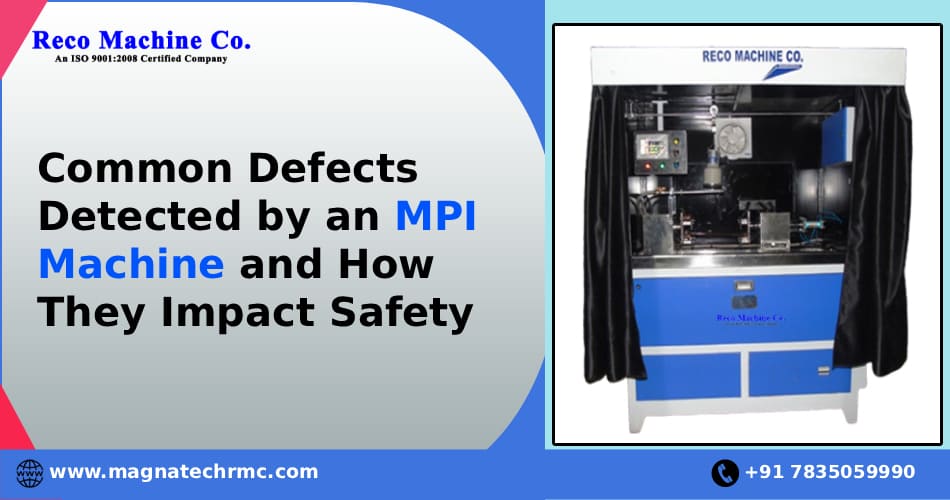
An MPI Machine is specifically designed to detect surface and near-surface defects in ferromagnetic materials without damaging the component. By revealing invisible cracks and discontinuities, it helps manufacturers prevent failures before they occur. Understanding the types of defects detected by MPI and how they impact safety is essential for industries aiming to maintain high standards of quality and reliability.
What Is an MPI Machine?
An MPI Machine is used in magnetic particle inspection, a non-destructive testing method that identifies flaws by magnetizing a component and applying fine magnetic particles. When there is a discontinuity such as a crack, the magnetic field is distorted, causing particles to gather at the defect location, making it visible under proper lighting.
This method is widely used because it is fast, cost-effective, and highly sensitive to surface-level and slightly subsurface defects. It is especially effective for inspecting parts such as shafts, gears, castings, forgings, and welded components.
Companies working with a trusted MPI Machine Manufacturer in Ghaziabad can ensure that their inspection processes meet both domestic and international safety standards.
Why Detecting Defects Is Crucial for Safety
Mechanical components often operate under high pressure, temperature, vibration, and load. Even minor defects can grow over time, eventually causing part failure. Such failures can result in:
- Equipment breakdowns
- Production downtime
- Costly repairs or replacements
- Environmental damage
- Serious injury or loss of life
By identifying defects early, MPI testing helps organizations take preventive action, improving product reliability and protecting people, infrastructure, and investments.
Common Defects Detected by an MPI Machine
Here are the most common defects that an MPI Machine can detect and why they are dangerous if left unnoticed:
1. Surface Cracks
Surface cracks are one of the most common and dangerous defects. They usually form due to fatigue, thermal stress, improper heat treatment, or overloading.
Impact on Safety:
Surface cracks can expand rapidly under repeated stress, leading to sudden failure of components such as shafts, axles, and pressure vessels.
2. Fatigue Cracks
Fatigue cracks develop after a component is subjected to repeated cycles of stress below its maximum load limit.
Impact on Safety:
These cracks grow gradually and can remain unnoticed until they reach a critical size, causing unexpected fractures during operation.
3. Welding Defects
Welding processes can introduce defects like lack of fusion, incomplete penetration, or cracks in the heat-affected zone.
Impact on Safety:
Weld defects weaken joints, making them vulnerable to failure under load, vibration, or temperature variations.
4. Shrinkage Cracks in Castings
Shrinkage cracks form during the cooling and solidification of molten metal in casting processes.
Impact on Safety:
These cracks reduce the load-bearing capacity of the part and may cause leakage or structural failure.
5. Quenching and Heat Treatment Cracks
Improper heat treatment or rapid cooling can introduce internal stresses, resulting in quench cracks.
Impact on Safety:
These cracks compromise the strength of critical components such as gears and bearings, increasing the risk of breakdown.
6. Laps and Seams
Laps are folded metal surfaces, while seams are elongated surface defects created during rolling or forging.
Impact on Safety:
These discontinuities can act as stress concentrators, initiating cracks under load.
7. Grinding Cracks
Grinding cracks are introduced during machining when excessive heat or pressure is applied.
Impact on Safety:
These cracks reduce fatigue resistance and may lead to early component failure.
8. Porosity Near the Surface
Porosity refers to small voids or gas pockets in the material.
Impact on Safety:
While small pores may not always be critical, clusters of porosity near the surface can weaken structural integrity.
Industries That Rely on MPI Testing
An MPI Machine is essential in industries where safety and reliability are non-negotiable:
- Automotive – inspection of crankshafts, axles, and gears
- Aerospace – critical aircraft components
- Oil and Gas – pipelines, valves, and pressure vessels
- Power Generation – turbines and rotors
- Railways – wheels, axles, and couplings
- Construction and Heavy Engineering – structural steel and weld joints
In all these sectors, MPI helps maintain safety standards and regulatory compliance.
Role of Magnatech RMC in Supporting Industrial Safety
Magnatech RMC is a recognized name in providing reliable inspection solutions, helping industries implement robust quality control systems. By offering advanced MPI equipment and technical support, the company enables manufacturers to detect defects accurately and maintain high safety standards.
Working with an experienced MPI Machine Manufacturer in Ghaziabad ensures that organizations receive equipment designed for precision, durability, and compliance with international testing standards.
Benefits of Using an MPI Machine for Defect Detection
Using an MPI Machine offers several advantages:
- Non-destructive and does not damage components
- High sensitivity to small surface defects
- Quick inspection time
- Cost-effective quality control
- Easy interpretation of results
- Suitable for both manual and automated inspection lines
These benefits make MPI a preferred choice for routine inspections and safety audits.
Defects such as cracks, weld flaws, laps, seams, and porosity may appear insignificant, but their impact on safety can be severe. Left undetected, they can lead to equipment failure, operational downtime, financial losses, and serious safety hazards.
An MPI Machine plays a vital role in identifying these defects early, allowing industries to take preventive measures and maintain high standards of quality and safety. With the support of reliable solution providers like Magnatech RMC and a trusted MPI Machine Manufacturer in Ghaziabad, organizations can strengthen their inspection processes and build safer, more reliable products.
Investing in proper NDT solutions is not just about compliance—it’s about protecting people, assets, and the future of industrial operations.